βœ“ Licensedβœ“ Insuredβœ“ Locally Ownedβœ“ Open 9AM–9PM Β· 7 Days
Detection guide Β· What to do next

Common Signs of a Rodent Infestation in Savannah Homes

Most rodent infestations start quietly and run for weeks before homeowners notice. Knowing what to look for β€” and how to read the signs accurately β€” catches problems early when they’re cheaper and easier to solve.

Rodent droppings and gnaw marks on wood β€” signs of infestation in Savannah homes

Droppings β€” the most reliable indicator

Droppings are the most consistent evidence of rodent activity and the fastest way to confirm species. Fresh droppings are dark, moist, and shiny; older droppings are dry, dull, and crumble when touched. Quantity and location both tell you something about the infestation scope.

House mouse droppings are tiny β€” about 1/8 inch, the size of small grains of rice, with pointed ends. They typically appear scattered across surfaces, in drawers, along baseboards, and under sinks. A single mouse can produce 50–75 droppings per day, so even a small infestation generates substantial dropping accumulation within a week.

Roof rat droppings are medium-sized β€” about 1/2 inch, similar to coffee beans, with pointed ends. They typically appear in attics, on top of insulation, along ceiling joists, and in upper-floor concealed spaces. A single roof rat produces 30–50 droppings per day; established attic populations leave hundreds in a few weeks.

Norway rat droppings are large β€” about 3/4 inch, blunt-ended (like olive pits). They typically appear in crawl spaces, near foundations, in basements, and along ground-level runways. Heavy concentrations near exterior foundation walls usually indicate active burrows nearby.
Sounds β€” what they mean and what they don’t

Scratching in the attic at dusk and dawn is one of the most distinctive rodent sounds. Roof rats are most active at these crepuscular hours, and the sound is typically rhythmic scratching against wood or insulation rather than the louder thumping of larger animals. Persistent attic scratching almost always indicates rodent activity.

Scuttling in walls at night usually indicates rodents traveling between floors via stud cavities. Mice produce light, fast scuttling; rats produce heavier sounds. The location of the sound (which wall, which floor) tells you about the travel route they’re using.

Loud thumping or running above ceilings during daytime is usually not rodents β€” it’s more likely raccoons, squirrels, or possums (wildlife, which is outside our scope; for those, a wildlife control operator is the right call). Rodents are predominantly nocturnal; daytime activity at high volume is a wildlife indicator.

Vocalizations (chittering, squeaking) sometimes indicate rodents, particularly during nesting periods or territorial disputes. Mouse vocalizations are higher-pitched and quieter; rat vocalizations are lower and louder. Most homeowners don’t hear vocalizations from established populations because the rodents avoid drawing attention.

Smells β€” what does rodent infestation actually smell like?

Active rodent populations produce a distinctive musky smell, particularly from urine accumulation in concealed spaces. The smell is often described as ammonia-like or musky-pungent, and it intensifies in humid conditions (which describes most of Savannah’s year). Strong rodent smell in a specific area of the house usually indicates a nesting site or heavy travel route.

Dead-rodent smell is much more acute β€” sharp, aggressive, distinctly different from active-population smell. A dead rodent in a wall or attic produces unmistakable odor that’s typically peak intensity at days 4–10 after death and fades over 2–6 weeks if not removed. In Coastal Georgia humidity, the smell is particularly aggressive.

If you’re smelling persistent ammonia or musk without seeing other evidence, an attic or crawl-space inspection is worthwhile β€” the source is often visible once you look. If you’re smelling decomposition, dead-rodent removal is typically a same-day service call (we cover this separately).

Gnaw marks and physical damage

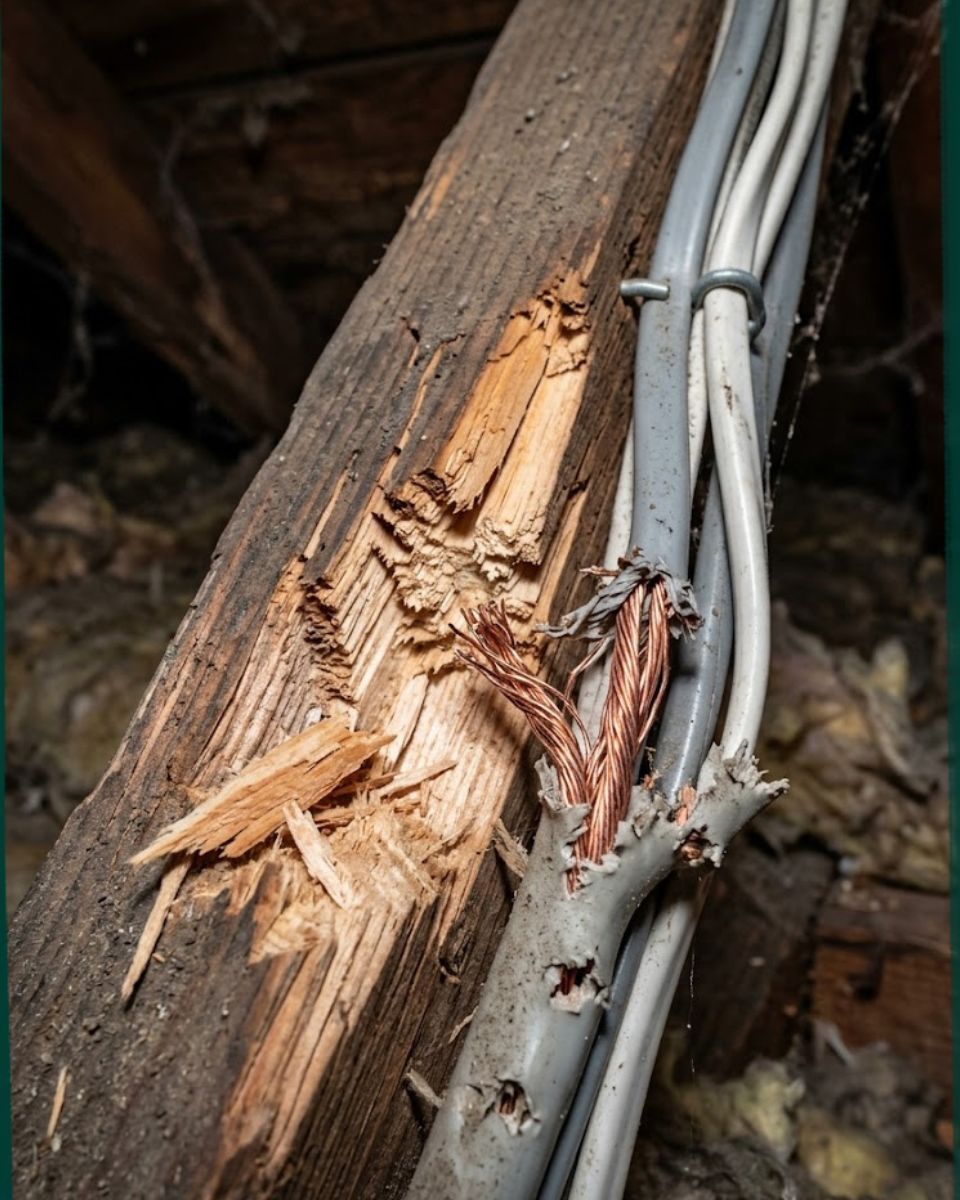
Rodents need to gnaw to keep their teeth from growing too long, and they gnaw constantly. Fresh gnaw marks are light-colored and have visible tooth striations; older gnaw marks darken with age. Common targets in Savannah homes: pipe lagging, wire insulation, structural wood at corners, stored food packaging, plastic storage bins, weather stripping around doors, and HVAC ducting.

Wire damage is one of the most consequential β€” chewed wire insulation creates fire risk and is a frequent insurance-claim trigger when fires occur. Periodic checks of wire runs in attics and along basement ceilings catch this before it becomes a problem.

Damage to wooden structural elements (joists, sill plates, framing) typically indicates established Norway rat populations. Fresh damage on these elements is a serious indicator that warrants prompt response.

Runways, smudge marks, and nesting evidence

Rodents are creatures of habit β€” they travel the same routes repeatedly. Over time, oil and dirt from their fur create dark smudge marks along walls, beams, and pipes at runway locations. These smudges are particularly visible along baseboards, around pipe penetrations, on attic joists, and along crawl-space sill plates.

Rodent runways through insulation appear as flattened or compressed tracks in attic blown-in. Fresh runways are crisp; older runways become disrupted as insulation settles back into place. Multiple parallel runways in the same area indicate established population travel.

Nests are typically built in concealed locations β€” wall voids, attic insulation pockets, crawl-space corners β€” and made of shredded material (paper, fabric, insulation, plastic). Finding a nest typically means there’s breeding activity at that location, which warrants prompt response.

What to do next

If you’ve identified one or two minor signs (occasional droppings in a single location, an isolated gnaw mark), DIY response is reasonable β€” snap traps, sealing visible entry points, monitoring for two to three weeks. If activity continues or worsens, escalate to professional inspection.

If you’ve identified multiple signs (droppings in several locations, sounds at night, smudge marks on baseboards), professional inspection is the right call. Multiple signs typically indicate established activity that DIY work won’t fully resolve.

If you’ve identified active or established rat activity (large droppings, runway evidence, structural damage), professional treatment is the appropriate response. Rat work consistently outperforms DIY attempts because of population dynamics and the regulatory restrictions on effective rodenticides.

Inspection-only service is available for situations where you want a professional opinion without committing to treatment. Useful for pre-purchase due diligence, insurance documentation, or when you’re uncertain about what the signs mean.

Need help with rodents in Savannah?

Same-day inspection, locally owned, 90-day exclusion warranty across Chatham, Effingham, Bryan, and Liberty Counties.

πŸ“ž Call (912) 305-0115

Related reading and services

Related blog posts: 2026 ultimate guide Β· rats vs mice Β· attic & crawl space.

Related services: rodent inspection Β· rodent removal Β· dead rodent removal.

From Forsyth Park to Tybee β€” We Cover All of Chatham

Trusted Coastal Georgia rodent specialists since 2023. Same-day inspection and quote β€” no charge.

πŸ“ž Call (912) 305-0115
πŸ“ž Call (912) 305-0115 β€” Same-Day Service