Everything a Savannah homeowner needs to know about rats and mice β how to identify what you’re dealing with, what treatment costs, what works and what doesn’t, and when DIY isn’t enough.

Three things stack on top of each other in Coastal Georgia. First, the port and downtown sewer system have supported Norway rat populations for nearly 300 years β these are some of the oldest established rat populations in the southeastern United States. Second, the mature live-oak and pecan canopy across most of the residential neighborhoods provides ideal roof-rat habitat with overhead travel routes connecting properties. Third, the year-round mild humidity means rodent breeding cycles don’t pause for winter the way they do in colder climates.
The result is a city where rodent pressure is essentially continuous rather than seasonal. Savannah homeowners don’t face a rodent ‘season’ β they face a baseline pressure level that varies in intensity but never fully drops off. This shapes how treatment works: aggressive single-event treatment that ignores ongoing pressure tends to fail within months because new rodents replace the cleared population. Sustainable treatment combines active removal with exclusion sealing that blocks re-entry from the broader population.
Norway rats (Rattus norvegicus) are the larger, ground-dwelling brown rats. Adults reach 12β18 inches including the tail, with a thick body, blunt nose, small ears relative to head size, and a tail shorter than the body. Norway rats prefer ground-level burrows and crawl spaces. In Savannah they dominate near the port, restaurants, marsh edges, and commercial corridors. Droppings are large (about 3/4 inch) with blunt ends.
Roof rats (Rattus rattus) are the smaller, climbing black rats. Adults reach 13β17 inches but with a longer tail than body, slender build, pointed nose, and large ears. Roof rats are arboreal β they prefer attics, upper floors, and overhead travel. They dominate Savannah’s canopy-heavy residential neighborhoods (Ardsley Park, Gordonston, Parkside). Droppings are smaller (1/2 inch) with pointed ends.
House mice (Mus musculus) are the small gray-brown mice. Adults reach 5β7 inches including the tail. They’re common throughout Savannah housing β particularly older homes with original construction features. Droppings are tiny (1/8 inch). Mice are typically more responsive to single-property exclusion work than rats are, because mouse populations are smaller in scale.
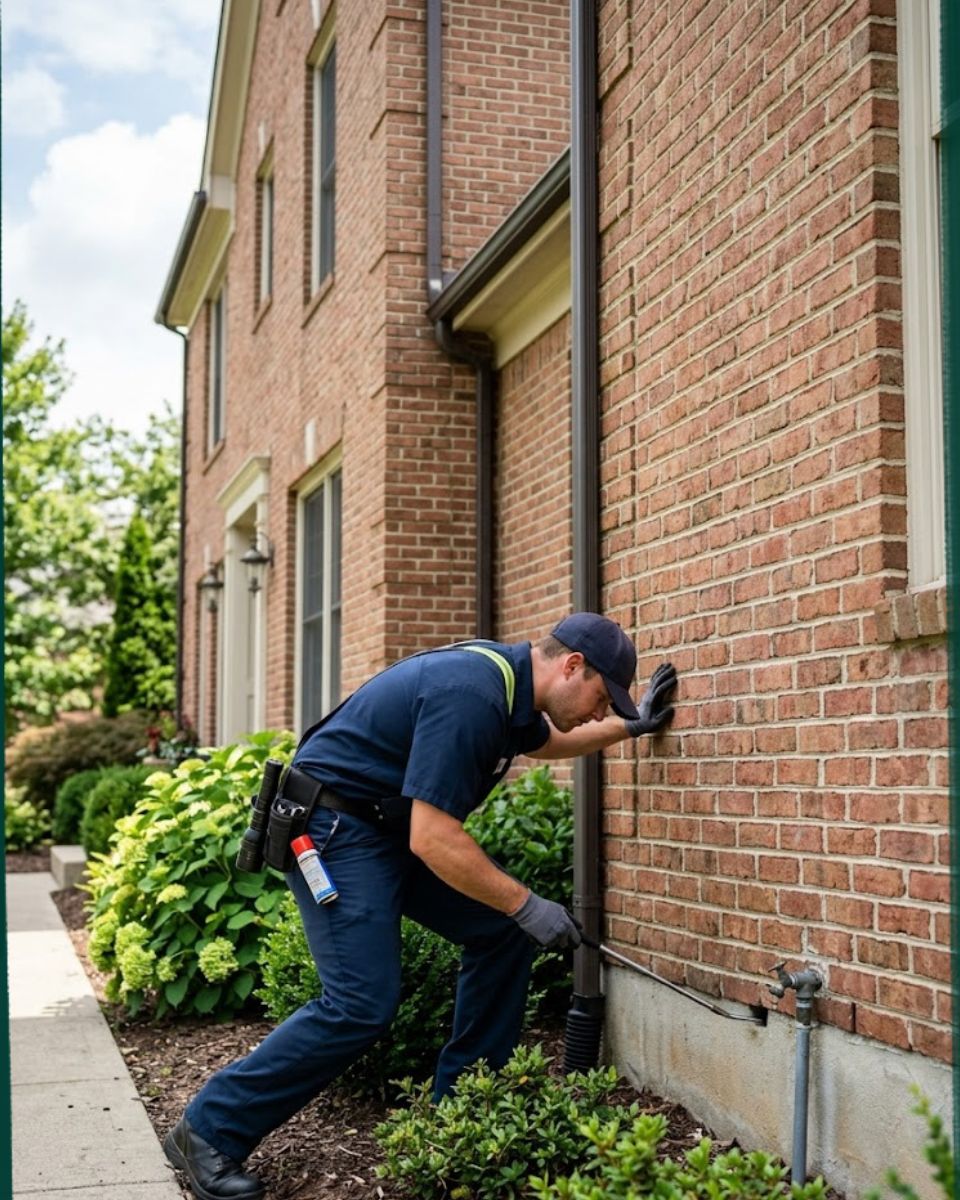
Species identification matters because treatment differs. Roof-rat work focuses on roofline and attic envelope; Norway rat work focuses on ground level and foundation. Mouse work focuses on small interior penetrations. Treatment designed for one species often misses the others.
The fastest identification clue is droppings. Find a few representative droppings and measure: tiny (1/8 inch, like coffee grounds) = mice; medium with pointed ends (1/2 inch, like raisins) = roof rats; large with blunt ends (3/4 inch, like olive pits) = Norway rats. Location also tells you something β droppings in the attic almost always indicate roof rats (or mice); droppings in the crawl space or near foundation almost always indicate Norway rats.
Sound cues help too. Scratching in the attic at night (typically dusk and dawn): roof rats. Scuttling in walls at night: mice or roof rats traveling between floors. Loud scampering above ceilings during the day: more likely raccoons or squirrels (wildlife, not rodents). Heavy thumping or vocalizations: wildlife, not rodents.
Pricing varies by property size, infestation level, and treatment scope. Standard ranges for Savannah residential work in 2026:
Pricing should always be quoted in writing before work begins. Be cautious of providers who give verbal estimates and then inflate scope mid-project.
DIY mouse control works for limited mouse activity in modern construction β snap traps, sealing visible interior penetrations, removing food sources, and reducing harborage. Most homeowners can clear isolated mouse activity in 2β4 weeks of consistent effort. The key is consistency and follow-through.
DIY rat control rarely succeeds. Rats are larger, more cautious, harder to trap consistently, and operate at population scales that overwhelm individual property exclusion attempts. Norway rats especially require restricted-use rodenticides (legally limited to licensed application) for population-level control, plus exclusion work that requires understanding of how rat populations move through neighborhoods. DIY rat work typically reduces activity temporarily without actually solving the problem.
Professional treatment is the right path when: you have rats (not just mice); the infestation has been active for more than a few weeks; you’ve tried DIY and the activity persists; you have a historic home with restoration-friendly requirements; you have a commercial property needing compliance documentation; or you simply don’t want to spend the time and risk on DIY work that may not succeed.
The single most effective prevention is exclusion sealing β physically blocking entry points so rodents can’t get inside. Hardware cloth (1/4 inch mesh) over vents and openings, copper mesh in masonry gaps, sealed sill plates and utility penetrations, and weather-tight roofline. Done thoroughly, exclusion keeps rodents out indefinitely; done partially, rodents find the gaps.
Food source reduction matters but is secondary. Pet food stored in sealed containers, bird feeders cleaned daily or removed seasonally, fruit-tree windfall picked up promptly, garbage in tight-lid bins. These reduce the attractiveness of your property to rodents but don’t eliminate broader-neighborhood pressure.
Harborage reduction (clearing ivy from foundation walls, trimming branches that touch the roof, removing wood piles from against the house) also helps but again is secondary to physical exclusion.
Call same-day if you’ve seen a live rat or mouse inside, you smell decomposition (dead rodent in a wall), you have visible feces on countertops or food-prep surfaces, you have small children or immunocompromised household members with active rodent presence, or your business is facing health-department inspection. These situations don’t wait.
For everything else β suspected attic activity, occasional sightings, prevention planning β schedule an inspection within the next week or two. Earlier intervention is always less expensive than delayed response.
Same-day inspection, locally owned, 90-day exclusion warranty across Chatham, Effingham, Bryan, and Liberty Counties.
π Call (912) 305-0115Related blog posts: signs of rodent infestation Β· 2026 pricing guide Β· rats vs mice.
Related services: rodent removal Β· exclusion sealing Β· residential programs.
Trusted Coastal Georgia rodent specialists since 2023. Same-day inspection and quote β no charge.
π Call (912) 305-0115