Trapping clears the rodents you have. Exclusion stops new ones from getting in. We audit your building envelope, identify every quarter-inch-plus gap, and seal them with materials matched to the surface β historic brick, modern siding, soffit metal, brick-pier foundation.

Rodent exclusion in Savannah is the systematic identification and sealing of every entry point on a building’s envelope that rodents could use to get inside. Mice exploit gaps as small as 6mm (about a quarter inch). Roof rats squeeze through quarter-inch gaps in soffits and roof returns. Norway rats enter through gaps in brick-pier foundations and garage door corners. Exclusion is the work that takes a building from rodent-vulnerable to rodent-resistant β and unlike trapping, it’s permanent if it’s done right. Whole-home Savannah exclusion typically runs $600β$2,200, depending on building size, age, and condition.
Exclusion is where most Savannah rodent jobs succeed or fail long-term. Trapping clears the active population, but if the entry points stay open, the population reseeds within months β sometimes weeks. Savannah’s housing stock makes exclusion particularly important and particularly nuanced.
The Historic District’s 19th-century buildings have brick-pier foundations, original lath-and-plaster, sill plates that were never sealed, and utility penetrations added over decades. Ardsley Park’s 1920s bungalows have soffit returns and gable vents that have been modified, repaired, and patched by multiple owners. Modern Pooler and Richmond Hill builds have engineered penetrations that look sealed but leave 1/4-inch gaps at every plumbing stub-out. Each housing type needs different exclusion materials and different techniques. A spray-foam-and-steel-wool approach works for a contractor doing weatherization; it fails as long-term rodent exclusion.
The other Savannah factor is humidity. Materials that hold up to year-round subtropical humidity are a narrower set than what works in drier climates. We use copper mesh (doesn’t corrode), stainless hardware cloth (rated for marine environments where needed), and mortar repair on masonry. Expanding foam alone, used as a structural seal, fails inside 2β3 years in Savannah humidity β even when rodents don’t chew it.
Full walk of the building exterior plus attic and crawl. We map every gap larger than 1/4 inch β quarter-coin test for mice, half-dollar test for Norway rats.
Each entry point photographed and located. Written scope and quote produced before any sealing starts. You see what we found before paying for the fix.
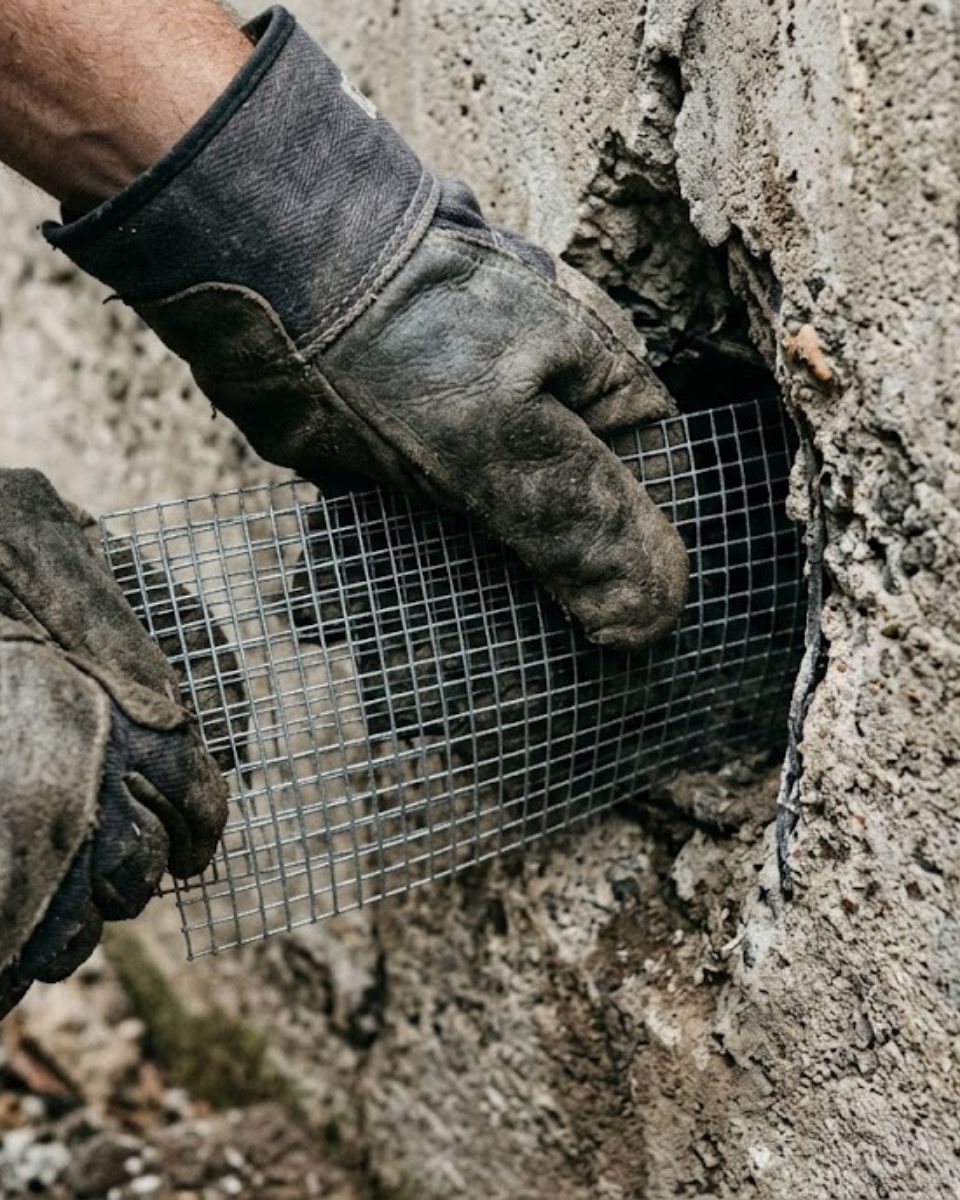
Each gap gets a material matched to its surface. Copper mesh in masonry. Hardware cloth on soffit metal. Mortar repair on historic brick. Metal flashing on roof gaps. Sealant where appropriate.
Work proceeds gap by gap. Larger work first (vents, foundation), smaller sealing after. Documentation updated as each gap is closed.
Final walk-through with the customer. Documentation delivered. 90-day warranty applies β re-entry through any sealed point means we come back at no charge.
Exclusion pricing scales primarily by the number of gaps to seal and the building’s complexity. A modern single-story home has fewer entry points than a 19th-century historic home with brick-pier foundation and unfinished attic.
| Scope | What's included | Typical range |
|---|---|---|
| Standard single-story home | Full envelope, typical gap count, modern construction | $600β$1,000 |
| Two-story or older home | Larger envelope, more soffit and roofline work | $900β$1,500 |
| Historic or brick-pier home | Restoration-friendly sealing, masonry repair, complex envelope | $1,400β$2,200 |
| Commercial property | Full perimeter exclusion with documentation | Quoted on inspection |
All scopes include initial inspection and a written quote before work begins.
Whole-building rodent exclusion across Savannah, Tybee Island, Pooler, and Coastal Georgia. Free audit and quote.
π Call (912) 305-0115Rodent control is the broader scope β inspection, trapping, sealing, monitoring. Exclusion is specifically the sealing piece. Most homeowners call us for rodent control (active problem), and exclusion is built into the program. Some customers call specifically for exclusion (no active problem, preventive sealing before moving in or after renovation), and we do that as a standalone scope.
House mice can pass through 6mm (1/4 inch) gaps β roughly the diameter of a pencil. Young rats can pass through gaps about the size of a quarter. Adult Norway rats need larger gaps but can chew existing small holes wider. The audit standard for rodent exclusion is ‘if a pencil fits, it’s an entry point’.
No β rodent exclusion targets the specific gaps rodents use, which are typically separate from the ventilation pathways the building needs. We don’t seal soffit ventilation, ridge vents, foundation vents, or attic ventilation. We seal the unintended gaps adjacent to those features. Your building’s designed ventilation stays intact.
Yes β restoration-friendly exclusion is one of our specialty scopes. We use copper mesh and mortar repair on historic masonry, hide hardware cloth behind original soffit returns, and color-match sealant to existing trim. The exclusion is invisible from the curb after we’re done. Several of our customers in the Historic District and Victorian District have used us specifically because of this.
Copper mesh is the gold standard β doesn’t corrode, doesn’t degrade in humidity, and rodents can’t chew through it. Stainless hardware cloth is the second tier for larger spans. Mortar repair on masonry lasts effectively forever. We avoid using expanding foam alone as a structural seal because it degrades in 2β3 years here.
Properly installed exclusion holds essentially indefinitely on the sealed sections. What changes over time isn’t the seal degrading β it’s new gaps appearing from building settling, weather damage, contractor work, or pest pressure on unsealed sections. Our 90-day warranty covers the sealed sections. Beyond warranty, follow-up sealing of new gaps is usually $100β$300 if needed.
Generally no β insurance treats exclusion as preventive maintenance rather than a covered repair. The exception is when rodent damage has occurred and the exclusion is part of the documented remediation; in that case some policies cover a portion of the work. We provide detailed scope documentation if you want to submit a claim.
Yes β our commercial exclusion work covers restaurants, warehouses, retail, healthcare, and offices. The audit, documentation, and material selection are similar to residential; the scale is larger and the documentation more formal. Commercial customers typically combine exclusion with ongoing maintenance programs.
Typically during, or trapping first then exclusion. Sealing entry points while rodents are still inside the building traps them in, which sounds like a feature but actually creates a worse problem β they die in walls, the smell is brutal, and they keep doing damage in the meantime. We sequence the work: active trapping first, then exclusion as the population clears, then final verification.
Related Savannah services: rat-specific exclusion programs Β· mouse-proofing sealing in Savannah Β· crawl-space and brick-pier sealing.
Trusted Coastal Georgia rodent specialists since 2023. Same-day inspection and quote β no charge.
π Call (912) 305-0115